
Influence Without Authority: Scripts for Everyday Situations

We have all been there.
You have the data. You have the technical expertise. You can clearly see the train wreck approaching if the project continues on its current trajectory.
But you don’t have the title.
You aren’t the Project Director, the client, or the department head. You are the technical expert, which often means you have full responsibility for the outcome but limited authority over decisions.
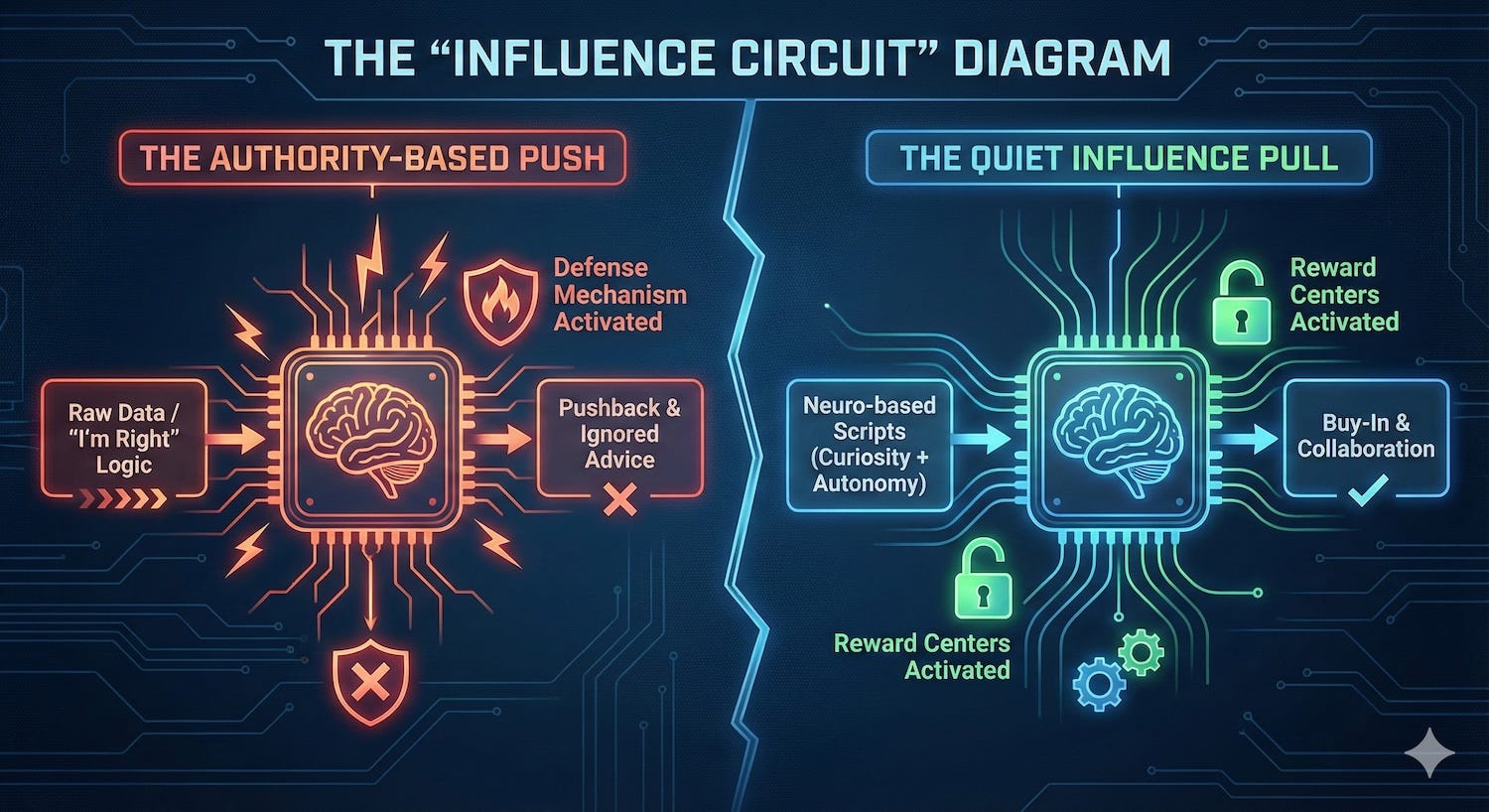
In my recently published book, Quiet Influence: A Neuroscience-Based Field Guide for Technical Professionals to Get Buy-In Without the Title, I explore the science of why logic alone rarely changes minds. The short version? When we challenge someone’s idea, their brain processes it as a threat to their status or autonomy. They don’t hear your data; they feel your attack.
To bypass that defense mechanism, you don’t need a promotion. You need better scripts.
Here are three neuroscience-backed scripts for common situations where you need to influence without authority.
Scenario 1: The “Scope Creep” Request
The Situation: A stakeholder or manager asks for a significant addition to the project without adjusting the deadline or budget.
The “Bad” Reaction: “We can’t do that. It’s impossible given the timeline.” (This triggers a resistance response; they view you as a blocker).
The “Quiet Influence” Script:
“I want to ensure we land this addition successfully because I see the value in it. However, given our current capacity, adding this feature will displace [Task X] or compromise the quality of [Task Y].
I can do the addition if we move the deadline, or we can keep the deadline and stick to the original scope. Which trade-off do you prefer we make?”
Why it works: You aren’t saying “no.” You are giving them autonomy (a key brain reward) to choose the trade-off. You are positioning yourself as a partner in solving the resource puzzle, not an adversary.
Scenario 2: Data vs. “Gut Feeling”
The Situation: You present an analysis, but a senior leader dismisses it because “my gut tells me we should go the other way.”
The “Bad” Reaction: “But the numbers clearly show you are wrong.” (This attacks their Status).
The “Quiet Influence” Script:
“That’s an interesting perspective, and given your experience with [similar past project], I can see why you’d lean that way.
Help me bridge the gap: My data is flagging a risk in [Area A], but your instinct suggests we are safe. What variable do you think this data set might be missing that you are seeing?”
Why it works: This is the Curiosity Pivot. Instead of fighting their intuition, you validate it (”given your experience”). By asking them to help you “bridge the gap,” you invite them to critique the data with you, rather than defending themselves against you.
Scenario 3: The Non-Responsive Peer
The Situation: You need input from a colleague in a different department to finish your report. They are ghosting you. You have zero authority over them.
The “Bad” Reaction: “I need this by 5:00 PM, or I’m telling the boss.” (This destroys Relatedness and future cooperation).
The “Quiet Influence” Script:
“I’m finalizing the report for the client tomorrow. I’m currently missing your section on [Topic].
I can proceed without it by using a placeholder assumption based on last year’s figures, but I’m worried that might undersell the work your team has done recently. Would you prefer to review the assumption I’m about to use, or can you shoot over the updated figures by 2:00 PM?”
Why it works: This leverages loss aversion. People are more motivated to avoid a loss (looking bad or underperforming) than to gain a benefit. You are also offering a choice (review the assumption vs. send the data), which returns control to them.
The Takeaway
Influence isn’t about being the loudest voice in the room or having “Manager” in your email signature. It’s about understanding how the human brain processes information.
When you stop trying to “win” the argument and start shaping the choices, you become the most influential person on the project, regardless of your title.
Want to go deeper? If you found these scripts helpful, they are just the tip of the iceberg. My new book, Quiet Influence: A Neuroscience-Based Field Guide for Technical Professionals to Get Buy-In Without the Title, is available now.
It’s a practical manual for engineers, scientists, and technical professionals who want to get their ideas heard, respected, and adopted.
Phil Charles, Professional Practice Academy